Have questions? Click here

Design Your Own Road
to BIM in Infrastructure

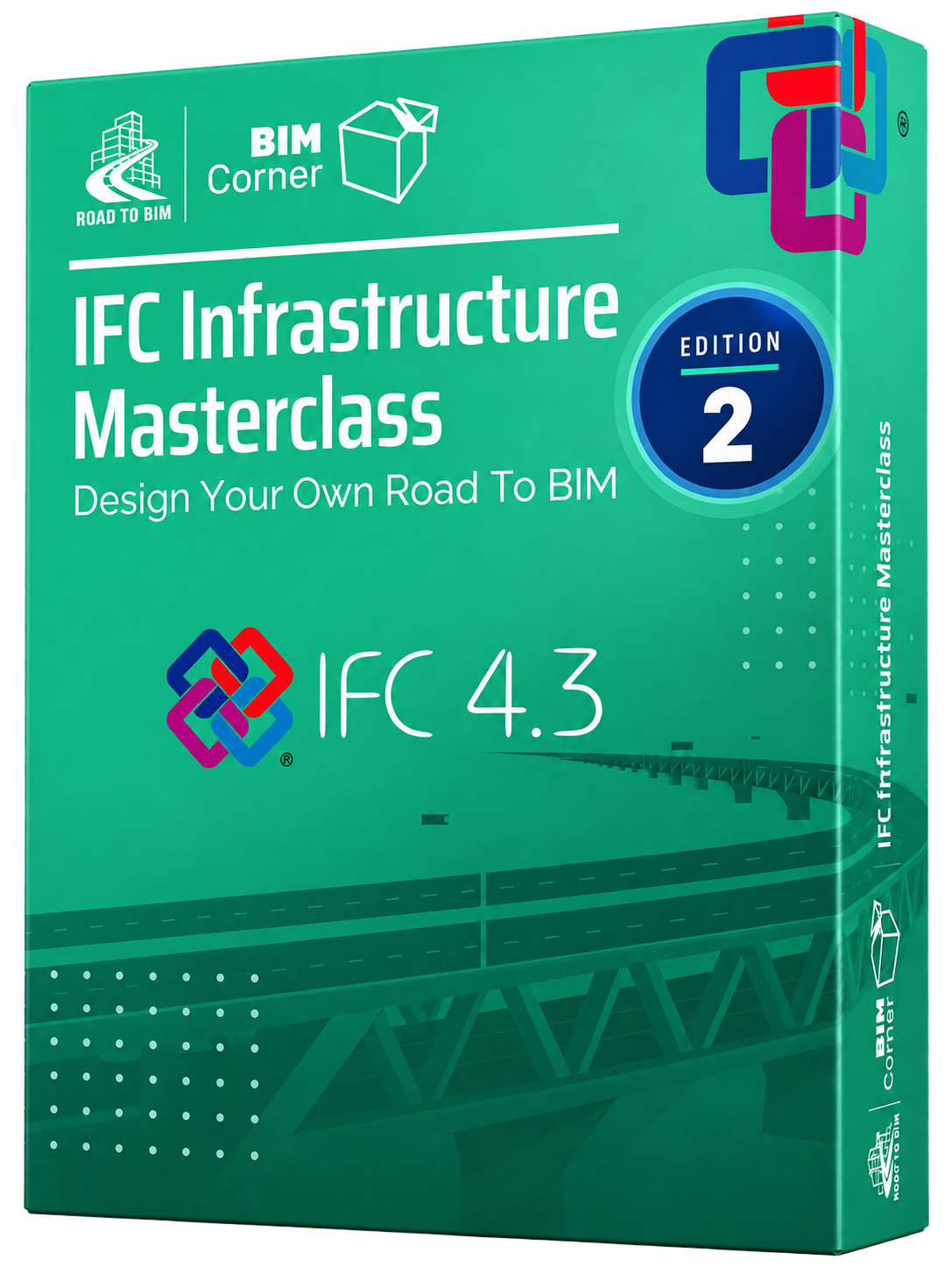
IFC Infrastructure Masterclass is a practical, expert-led program that helps you gain real confidence in using open BIM standards in infrastructure projects.
This is not another collection of disconnected tutorials.

It’s a structured path that shows you how BIM, IFC, and information actually work together in civil infrastructure.

In just 6 weeks, you will build the competencies needed to design, model, exchange, and manage information using IFC 4.3 – with clarity, purpose, and consistency.

Registration to second edition starts in

Days
Hours
Minutes
Seconds

What are the current challenges in using openBIM in infrastructure projects?

Lack of a consistent approach to IFC in infrastructure projects

IFC is applied selectively or incorrectly, leading to misinterpretation and issues during model verification.

Lack of awareness of the model’s intended use

Models are created without a clearly defined information purpose. There is a lack of understanding of what data is required at each project stage and how to prepare models for cost estimation, coordination, construction, or asset management.

Lack of standardization in information structuring

Information in models is recorded in inconsistent ways - using non-standard properties, descriptions, or object names. This prevents automation, validation, and efficient data exchange.

Issues with multidisciplinary model exchange

Models lose information during export and import, making coordination between teams time-consuming and inefficient.

But what if it didn’t have to be this way?

Sure, you can try to figure this out on your own - but…

1. Knowledge of IFC and infrastructure BIM is fragmented and inconsistent

Information available online is fragmented, often contradictory, and largely focused on building construction. Clear guidance on how to apply IFC in infrastructure projects in a consistent and informed way is missing.

2. Companies rarely share real-world know-how

Practical experience from BIM and IFC implementations in infrastructure remains internal to organizations. Key decisions, mistakes, and lessons learned rarely make their way into public materials or tutorials.

3. Official standard documentation is difficult to understand

IFC specifications are extensive, highly technical, and written in the language of standards rather than practitioners. Without project context, it is difficult to understand what truly matters in day-to-day work.

There’s a smarter way forward!

Learn from a practitioner with real experience

in IFC 4.3 and open standards for infrastructure.


The mistakes have already been made, the decisions tested, and the conclusions organized into a coherent process for working

with BIM  in infrastructure.

Join this hands-on training

01

Introduction to Civil Infrastructure

Master the ecosystem and standards behind digital infrastructure

02

Practical Infrastructure Modeling

Build models that deliver real project value from design to as-built

03

Model Use Cases

Turn models into powerful real-world use cases

04

IFC 4.3 Fundamentals

Understand the foundations of IFC 4.3 standard

05

Core Conepts of IFC 4.3

Control the core information that makes IFC work

06

From Standards to Implementation

Put standards into action with real tools and workflows

Design your own
Road to BIM

01

Introduction to Civil Infrastructure

Master the ecosystem and standards behind digital infrastructure

02

Practical Infrastructure Modeling

Build models that deliver real project value from design to as-built

03

Model Use Cases

Turn models into powerful real-world use cases

04

IFC 4.3 Fundamentals

Understand the foundations of IFC 4.3 standard

05

Core Conepts of IFC 4.3

Control the core information that makes IFC work

06

From Standards to Implementation

Put standards into action with real tools and workflows

LIVE Workshop Structure

Set your learning pace

Before each workshop, you’ll receive a short pre-work checklist, along with optional stretch tasks to complete between sessions.​
Attend the 2-hour live session each week, or go deeper to accelerate your implementation. The choice is yours.

Course agenda

All workshops will be recorded for on-demand viewing

WORKSHOP 1
Date: 17.03.2026

Introduction to Civil Infrastructure

  • What infrastructure is and how it differs from vertical construction
  • The infrastructure ecosystem and key stakeholders
  • Core data standards: InfraGML, CityGML and IFC
  • The role of GIS, spatial data, and built assets
  • Contract types and typical project phases
  • How to read and apply standards documentation in practice
  •  
WORKSHOP 2
Date: 24.03.2026

Practical Infrastructure Modeling

  • The types of models used across the project lifecycle, from existing conditions to As-Built

  • The role of design, multidisciplinary, coordination, and construction site models

  • How models evolve from inventory through delivery

  • What makes a model truly useful beyond geometry

  • Key parameters and structured information, including classifications, discipline codes, properties, materials, and statuses

WORKSHOP 3
Date: 31.03.2026

Model Use Cases

  • Models for specific project use cases

  • From existing conditions to coordinated design

  • Visualization, drawings, and information exchange

  • Clash detection and construction planning

  • Quantities, earthworks, and machine control

  • As-Planned vs. As-Built comparison

  • Handover to Asset Management and geotechnical context

WORKSHOP 4
Date: 14.04.2026

IFC 4.3 Fundamentals

  • Introduction to IFC for infrastructure and its evolution

  • What’s new in IFC 4.3 and its infrastructure domains

  • Core objects and classes such as IfcProduct, IfcElement, IfcAlignment, and IfcSpatialElement

  • Infrastructure-specific entities like IfcRoad, IfcBridge, and IfcRailway

  • Spatial breakdown structure and model organization

  • Attributes and relationships that ensure correct semantics and reliable data exchange

WORKSHOP 5
Date: 21.04.2026

Core Concepts of IFC 4.3

  • Coordinate reference systems and georeferencing

  • Geometry representation principles

  • Presentation layers and model organization

  • Property sets and quantity sets

  • Data types and structured information

  • Materials and classifications, including bSDD

  • Groups and systems

  • Basic principles of data quality control

WORKSHOP 6
Date: 28.04.2026

From Standard to Implementation

  • Data and structure mapping based on standards

  • Software capabilities and limitations

  • Tool and process auditing

  • Standardization and implementation processes

  • Practical implementation example using Trimble Quadri/Trimble Connect Object Manager

Outcomes after the masterclass

Confidence in working
with IFC 4.3

You’ll gain a real understanding of IFC 4.3 for infrastructure - objects, relationships, spatial structures, and information. IFC will stop being a “black box” and become a predictable, reliable working tool.

Stuctured and consistent information

You will organize your knowledge of BIM in infrastructure and build a coherent approach to IFC. You’ll understand how standards, models, and information connect into a logical system instead of a collection of random decisions.

Models ready for real-world
use cases

You’ll create models prepared for specific use cases: coordination, quantity take-offs, machine control, asset management, and As-Built vs. As-Planned comparisons.

Standardization ready for implementation

You’ll learn how to build information standards that can be scaled across projects and teams - instead of “reinventing BIM” every time.

Your inctructor

My name is Marcin, and for over 10 years I’ve worked with BIM in infrastructure projects – as a designer, BIM Coordinator, BIM Manager and Product Manager developing open-standard workflows.

I specialize in openBIM, particularly IFC 4.3, with hands-on experience in software implementation, standardization, and advisory work.

I’m also the co-founder of BIM Corner, one of the largest AEC blogs, with 200+ published articles on BIM and open standards, and a speaker at international events such as Trimble Dimensions and buildingSMART conferences.

Hands-On Experience

E39 Kristiansand vest - Mandal Ost

A major highway project on Norway’s southern coast. The 19km stretch includes multiple tunnels and bridges, built to improve safetry, reduce travel time, and support regional connectivity

Trimble Quadri & Novapoint IFC 4.3 implementation

Led and supported the implementation of IFC 4.3 within Trimble Quadri and Novapoint, focusing on infrastructure data structures, alignment modeling, information management workflows, and ensuring compliance with openBIM standards for reliable data exchange.

Why this matters for you


This masterclass distills proven IFC 4.3 workflows from real infrastructure projects – so you can deliver cleaner exports, validate models with confidence, and structure information correctly from the start.

Instead of fixing problems at the end of the project, you’ll build models that work – technically, semantically, and operationally.

Value of the course

01

Introduction to Civil Infrastructure

Master the ecosystem and standards behind digital infrastructure

399 EUR

02

Practical Infrastructure Modeling

Build models that deliver real project value from design to as-built

399 EUR

03

Model Use Cases

Turn models into powerful real-world use cases

399 EUR

04

IFC 4.3 Fundamentals

Understand the foundations of IFC 4.3 standard

399 EUR

05

Core Conepts of IFC 4.3

Control the core information that makes IFC work

399 EUR

06

From Standards to Implementation

Put standards into action with real tools and workflows

399 EUR

Value of the course

01

399 EUR

Introduction to Civil Infrastructure

Master the ecosystem and standards behind digital infrastructure

02

399 EUR

Practical Infrastructure Modeling

Build models that deliver real project value from design to as-built

03

399 EUR

Model Use Cases

Turn models into powerful real-world use cases

04

399 EUR

IFC 4.3 Fundamentals

Understand the foundations of IFC 4.3 standard

05

399 EUR

Core Conepts of IFC 4.3

Control the core information that makes IFC work

06

499 EUR

From Standards to Implementation

Put standards into action with real tools and workflows

Total value

2494 EUR

100% MONEY-BACK GUARANTEE

14-day refund, no questions asked.

The registration ends in

Days
Hours
Minutes
Seconds

If you are interested in the training and want to learn more, just reach out at:

Get access to the course

IFC INFRASTRUCTURE WORKSHOP
PRACTICAL KNOWLEDGE

IFC INFRASTRUCTURE WORKSHOP
FULL ACCESS

IFC INFRASTRUCTURE WORKSHOP
SOFTWARE TRAINING

100% MONEY-BACK GUARANTEE

14-day refund, no questions asked.

Who this is for

Perfect for:

Not a fit if:

Frequently Asked Questions

The IFC Infrastructure Masterclass is a flexible, self-paced program with 10–15 hours of content. It includes 6 workshops (up to 2 hours each) plus live Q&A sessions. You can attend live or watch the recordings anytime – without disrupting your daily work.

I recommend 3-4 hours per week, but with lifetime access, you can learn at your own pace. The course follows an 80:20 practice-to-theory approach, so you’ll start applying what you learn from day one.

You’ll receive lifetime access to this edition of the course once you enroll. That includes all video lessons, downloadable resources, and any updates made within this version.

You can revisit the material anytime – there’s no expiration. Please note that access applies to this specific edition of the course and does not automatically include future new editions.

No, paid software is not required for the core concepts. The Infrastructure Masterclass focuses primarily on free IFC viewers and open-standard workflows.

For workshop 6, we’ll use Trimble Quadri/Trimble Connect Object Manager with a 30-day trial license.

No, you won’t miss anything. All workshops are recorded, and you’ll receive lifetime access to the full recordings.

If possible, we recommend attending live to take part in the interactive Q&A. However, you can always send your questions afterward, and we’ll make sure they’re answered.


Yes. The workshops are fully online and open to participants worldwide. The live sessions are scheduled in CET (Central European Time), but you can join from any country.

If the time doesn’t suit your time zone, you’ll have access to the recordings and can watch them anytime.

Of course. Team access and company invoices are available. Simply contact us at marcin.pszczolka@bimcorner.com, and I’ll arrange all the necessary documents.

Good to know: you can enroll in the IFC Infrastructure Masterclass now as an individual. If your company decides to cover the cost later, we’ll handle all the formalities. We’ll issue a correction invoice, refund your payment, and reissue the invoice to your company.


No prior knowledge or experience is required. The course starts from the fundamentals and gradually builds your understanding of IFC and openBIM from the ground up.

If you’re completely new, you’ll be fully supported. And if you already have experience, you’ll still gain structured, practical insights that help you work more confidently and consistently.

Absolutely. This training goes far beyond the basics and includes practical insights, lessons learned, and real-world solutions gathered from infrastructure projects.

Even experienced BIM professionals will structure their knowledge, close existing gaps, and discover new, practical approaches to working with IFC and open standards.

And if you feel you didn’t gain value, we offer a 100% money-back guarantee – so there’s no risk.

I want you to feel 100% confident in your decision. That’s why we offer a 14-day money-back guarantee.

Enroll, explore the lessons, and start learning about IFC and openBIM risk-free. If you decide the course isn’t the right fit, simply let us know within 14 days of purchase, and I’ll refund your full tuition – no questions asked.

(I might ask for feedback to improve, but that’s entirely up to you 😉.)

Fast, simple, and unconditional. Your learning experience comes first.

Still have questions?

Ask about the training